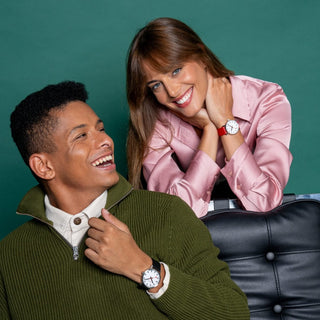
A conversation with Maximilian, the designer behind the Doppio Bauhaus Inspired about Bauhaus principles, functional beauty, and the creative process behind the watches.
Behind every carefully considered object lies a process of observation, refinement, and design decisions that often remain invisible to the person wearing it. The Doppio Bauhaus Inspired continues MONDAINE’s exploration of clarity, geometry, and functional design, drawing on principles rooted in modernist thinking. We spoke with Maximilian, the designer behind the watch to understand how the idea developed, what influences shaped its visual language, and how simplicity and precision come together in the final object.

MONDAINE: What first drew you to designing objects, and how did your journey lead you to watch design?
Maximilian: I grew up in Zürich, where watches are woven into the fabric of Swiss culture. My foundation began at the Goldsmith and Watchmaker School in Pforzheim, where I learned the discipline of craftsmanship through material, gesture and making by hand. Later, at HEAD – Genève, specializing in watch design, I became more deeply acquainted with the processes and the thinking behind the object. From there, my path into the Swiss watch industry felt very natural.
MONDAINE: When you approach a new project, what is the first question you ask yourself before starting the design process?
Maximilian: The first question is always very simple: why should this object exist, and what will it mean to the person who lives with it every day? I believe useful objects can also be deeply beautiful, and that beauty often comes from clarity. With the Doppio Bauhaus Inspired, that meant thinking carefully about the wearer, the context, and how the watch could feel both immediate and enduring.
MONDAINE: The Bauhaus philosophy is often summarized as “form follows function.” How does that principle influence the way you approach designing objects today?
Maximilian: What remains so powerful about Bauhaus is that it was never only a style. It was a way of thinking with great clarity about purpose, proportion and modern life. More than a century after its founding in 1919, that remains relevant. For me, form follows function does not mean something austere; it means that every line, every surface and every detail should have a reason to be.
MONDAINE: Colour can completely change the perception of an object. How do you think about colour when designing something that is meant to remain timeless?
Maximilian: Unlike many digital products, which are shaped by constant updates, a watch has a reassuring permanence. It stays with someone over years, even decades, while life around it changes. For that reason, colour must do more than attract attention in the moment, it has to carry emotion with restraint. In the Doppio Bauhaus Inspired, I wanted to bring in the optimism and clarity of Bauhaus colour, but in a way that still feels composed and lasting.
MONDAINE: What was the original idea or starting point that led to the creation of the Doppio Bauhaus Inspired?
Maximilian: The starting point was the idea of Bauhaus as a place of radical clarity and creative freedom. Weimar, it felt almost like an island of new thought: a meeting point for art, craft and modern industry. I was interested in translating that spirit into the Doppio, not as a quotation from history, but as something alive in the present.
MONDAINE: The watch introduces distinctive elements such as the double-line hands and indexes, as well as subtle geometric references on the dial. How did these elements develop during the design process?
Maximilian: I was interested in loosening the dominance of the numerals and creating a more open, more graphical reading of time. The Doppio already offered a strong foundation through its simplicity, its duality and its material clarity, particularly in steel and glass. Within that framework, the dial became a kind of field for composition, where geometric references to Bauhaus could be introduced with lightness and precision.
MONDAINE: When you look at the finished Doppio Bauhaus Inspired today, what detail in this watch are you personally most proud of?
Maximilian: What I am most pleased with is the balance. The watch carries colour and geometry in a way that feels expressive, but never excessive. It has presence, yet it remains calm. That sense of restraint is important to me, because it allows the watch to be both distinctive and easy to live with.
MONDAINE: Good design often becomes almost invisible in everyday life. When someone wears this watch for many years, what do you hope they continue to notice or appreciate about it?
Maximilian: I hope they continue to discover its details. Good design often reveals itself slowly. And perhaps, over time, the watch also becomes a quiet reminder that our sense of the future is always shaped by how thoughtfully we understand the past.
Click here to discover the collection.
Learn more about Maximilian here.